
The Future of Regional Airports: From Transport Nodes to Multi-Purpose Hubs


For decades, regional airports have played a supporting role within the wider aviation network—providing local connectivity, relieving pressure from major hubs, and enabling point-to-point travel.
But that role is no longer enough.
Driven by changes in passenger behaviour, the growth of e-commerce, and increasing pressure on land use, regional airports now have a clear opportunity to evolve into something far more valuable: multi-purpose hubs that integrate aviation, logistics, and commercial activity into a single, high-performing ecosystem.
This is not simply an expansion of function. It is a redefinition of what an airport can be.
A Perfect Storm of Opportunity

A number of structural shifts are creating the conditions for change:
Continued growth in e-commerce and demand for rapid fulfilment
Capacity constraints at major hubs like Heathrow
Changing passenger expectations favouring convenience and regional access
Increased pressure on land to deliver higher-value, mixed-use development
Stronger focus on sustainability and decentralised infrastructure
Regional airports sit at the intersection of all of these forces.
They already possess the fundamentals:
Airside access
Strategic locations
Established infrastructure
Significant land holdings
The opportunity lies in how these assets are leveraged.
The Missed Opportunity: Why Many Regional Airports Are Still Struggling

Despite this potential, many regional airports across the UK and Europe continue to operate under significant financial pressure.
A large proportion remain heavily reliant on:
Seasonal passenger demand
Low-cost carrier agreements
Limited and often volatile route networks
This creates a fragile and unpredictable revenue model—one that is highly exposed to airline strategy and economic cycles.
As a result, many smaller regional airports:
Operate on thin margins or at a loss
Depend on public funding or local authority backing
Struggle to justify long-term investment
The issue is not a lack of opportunity—but a lack of diversification.
A Case in Point: Teesside International Airport

A strong example of this shift in action can be seen at Teesside.
Following its return to public ownership in 2019, the airport has undergone a strategic repositioning—not simply to recover passenger numbers, but to redefine its role within the regional economy.
Rather than relying solely on commercial aviation, Teesside has focused on creating a diversified airport ecosystem through the development of its wider estate.

Key initiatives include:
Teesside Freeport designation, unlocking tax and planning incentives to attract investment
Development of large-scale logistics and advanced manufacturing zones
Expansion of cargo operations, including freight handling capability
Investment in business parks and commercial space adjacent to the airport
Positioning itself as a hub for sustainable aviation and future fuels
This approach reflects a clear understanding that the value of the airport lies not just in its runway—but in the land and infrastructure that surround it.
Teesside is not alone, but it is one of the clearest UK examples of an airport actively transitioning from a single-use transport node into a multi-purpose economic hub.
From Single-Use Infrastructure to Multi-Revenue Platforms

The fundamental shift required is one of mindset.
Rather than viewing the airport as a single-use transport facility, it must be seen as a multi-revenue platform.
A traditional airport model generates income primarily through:
Passenger throughput
Airline and landing fees
Retail linked to passenger flows
A diversified model layers in:
Logistics and warehousing leases
Business parks and commercial tenancies
Aviation-adjacent uses such as MRO and training
Hospitality and destination-based revenue
The difference is not incremental—it is transformational.
The Rise of the Hybrid Airport Model

We are now seeing the emergence of a new type of airport: one that combines multiple sectors into a single integrated system.
Aviation as the Anchor
Aviation remains central—but becomes part of a broader ecosystem.
Regional airports are well placed to support:
Business aviation and FBO growth
Pilot training and specialist aviation services
MRO facilities
Emerging technologies such as eVTOL and sustainable fuels
Logistics as a Growth Engine

Logistics represents one of the most immediate and scalable opportunities.
Regional airports offer:
Direct air-to-ground connectivity
Strong road network access
Space for flexible, large-scale development
There is also a growing overlap between aviation and logistics design—where the efficiency of hangars informs high-performing warehouse environments.
Commercial and Mixed-Use Development
Regional airports can evolve into:
Business and innovation parks
Advanced manufacturing clusters
Hospitality and leisure destinations
In doing so, they become anchors for regional growth, not just transport infrastructure.
Designing for Integration, Not Separation
Unlocking this potential requires a shift in design thinking.
Instead of segregating functions, future airport masterplans must:
Integrate aviation, logistics, and commercial uses
Enable phased and flexible development
Create shared infrastructure systems
Maintain operational clarity across complex environments
Sustainability as a Catalyst
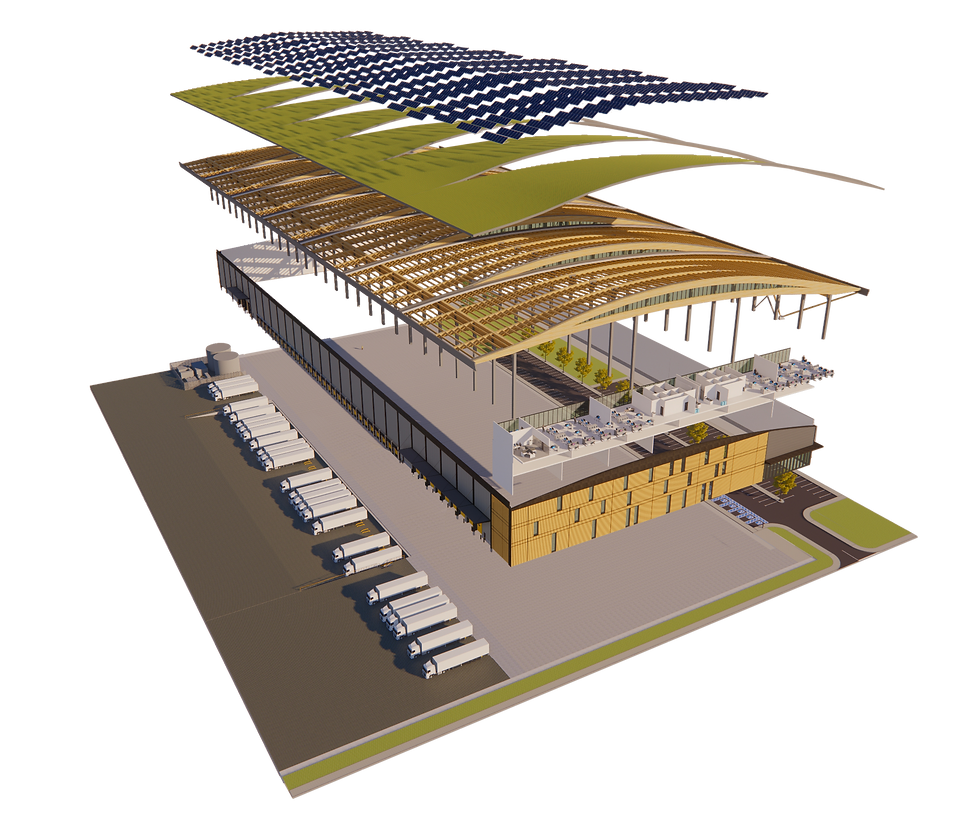
Multi-purpose hubs support:
Reduced transport distances
Smarter land use
Opportunities for on-site energy generation
Regional airports can lead in:
Low-carbon logistics
Sustainable aviation infrastructure
Integrated energy systems
The Commercial Case for Diversification
Diversification creates resilience:
Aviation revenue is cyclical
Logistics provides stable, long-term income
Commercial development drives additional value
Together, they create a stronger and more sustainable financial model.
A New Role for Regional Airports
The future regional airport is not a smaller version of a major hub.
It is:
A logistics node
A business destination
A centre for innovation
A connector between industries
In short, it becomes infrastructure with a purpose beyond aviation.
Looking Ahead
The opportunity is clear.
Regional airports that embrace this evolution will:
Unlock new revenue streams
Strengthen their long-term viability
Play a central role in regional economic growth
Teesside demonstrates what is possible when this shift is taken seriously.
The challenge now is for others to follow.


Comments