
Water: The Next Great Design Challenge for Data Centres
- Gebler Tooth Architects

- 3 days ago
- 5 min read
As AI drives unprecedented growth in computing demand, water is emerging as one of the defining considerations in the design of the next generation of data centres.

Introduction
For decades, conversations around data centres have focused on power.
Grid capacity, energy resilience and electrical efficiency have become defining considerations in the planning and design of digital infrastructure.
Today, another resource is rapidly moving to the forefront.
Recent research estimates that AI data centres consumed almost one trillion litres (264 billion gallons) of water globally in 2025, while demand is expected to continue rising as artificial intelligence accelerates the deployment of higher-density computing infrastructure.
Although much of the public debate has focused on electricity consumption, water is becoming an equally important consideration in determining how—and where—the next generation of data centres can be developed.
For architects and masterplanners, this is no longer simply a mechanical engineering issue. Water availability, cooling strategy and long-term resource resilience are increasingly influencing site selection, campus planning and future expansion.
Why Water Is Becoming a Strategic Resource
The rapid advancement of artificial intelligence is transforming not only the scale of digital infrastructure, but also the resources required to support it.
As AI models become larger and more computationally intensive, the data centres that power them are housing increasingly dense server racks capable of generating significantly higher levels of heat than traditional computing environments. While electricity remains fundamental to operating these facilities, the challenge of removing that heat efficiently is placing greater emphasis on another critical resource: water.
Recent estimates suggest that AI data centres consumed almost one trillion litres (264 billion gallons) of water globally in 2025, with demand expected to continue rising as AI adoption accelerates and hyperscale developments expand. At the same time, academic research indicates that global AI-related water withdrawals could increase substantially over the coming decade if current growth trends continue.
This is occurring against a backdrop of increasing pressure on freshwater resources. Climate change, population growth and more frequent periods of drought are prompting governments, utilities and infrastructure providers to reconsider how finite water resources are managed. While the availability of water varies significantly between regions, the direction of travel is clear: responsible water management is becoming a strategic consideration for all major infrastructure projects.
For the data centre industry, this represents a shift in thinking. Discussions can no longer focus solely on megawatts, grid connections and power usage effectiveness (PUE). Increasingly, developers, designers and operators must also consider water usage effectiveness (WUE), cooling resilience and the long-term environmental impact of the systems they specify.
For architects and masterplanners, the implications extend far beyond the building itself. Site selection, campus layout, cooling strategies, landscape design, drainage infrastructure and future expansion all play a role in creating data centres that are not only operationally resilient, but also capable of responding to the environmental challenges of the decades ahead.
Why Cooling Matters
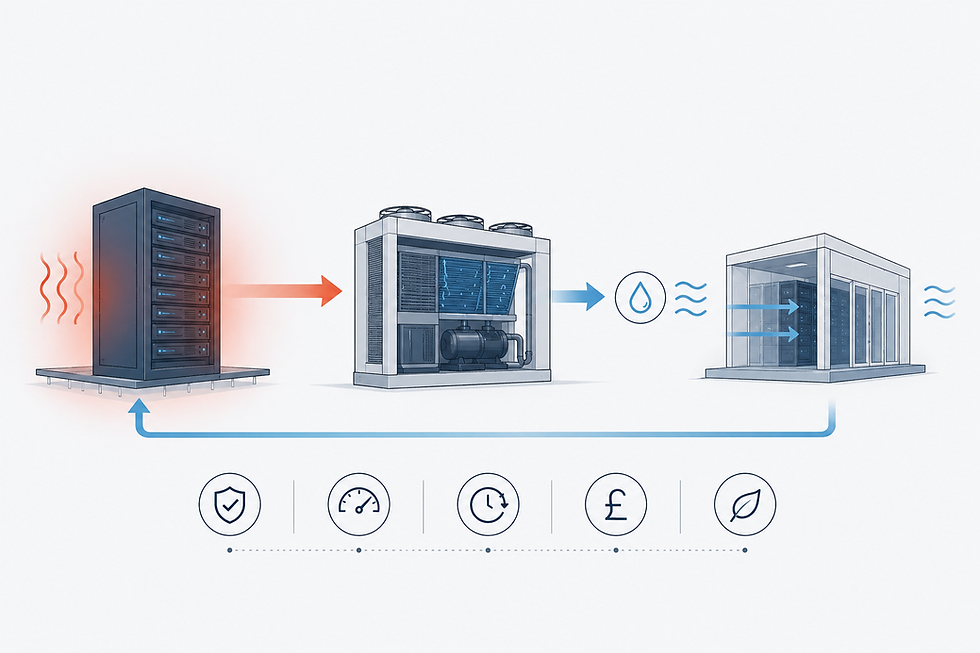
Almost every watt of electricity consumed by a server becomes heat.
That heat must be removed continuously to ensure equipment operates reliably. As computing power increases, so too does the amount of heat generated.
Historically, many facilities relied primarily on air cooling, using large computer room air handlers, chillers and carefully managed airflow.
However, AI workloads are changing this equation.
Higher-density server racks can generate several times more heat than conventional enterprise equipment. This is driving increased adoption of liquid cooling technologies and more sophisticated cooling strategies.
The question is no longer simply how much power can a data centre accommodate? It is increasingly how can that heat be removed efficiently and sustainably?
Understanding Water Usage
Water plays an important role in many cooling systems, particularly where evaporative cooling is used.
Evaporation is highly effective at rejecting heat while reducing energy consumption compared with traditional mechanical refrigeration. However, this efficiency comes with a trade-off: water consumption.
In regions where water resources are constrained, this raises important questions.
How should developments balance operational efficiency with responsible resource use?
How resilient are cooling strategies during periods of drought?
Could future planning policies place greater emphasis on water availability alongside electricity capacity?
These considerations are becoming increasingly relevant as new campuses are proposed across the UK and internationally.
Designing for Water Resilience
Water resilience is not achieved through a single technology. It is the result of integrated planning across the entire campus.
Key principles include:
Selecting the Right Cooling Strategy
Different climates, operational requirements and rack densities favour different approaches.
These may include:
Air-cooled systems
Direct evaporative cooling
Indirect evaporative cooling
Rear-door heat exchangers
Direct-to-chip liquid cooling
Immersion cooling
Hybrid cooling systems
Each presents different trade-offs between water use, energy efficiency, maintenance requirements and future adaptability.
Designing for Future Technologies
Cooling technologies are evolving rapidly.
Facilities designed today must accommodate equipment that may not yet be commercially widespread.
Flexible plant areas, expandable utility corridors and adaptable service routes allow campuses to evolve without major redevelopment.
Good masterplanning creates resilience against technological change.
Considering the Whole Site
Water strategy extends well beyond cooling equipment.
Architects increasingly need to consider:
Surface water management
Rainwater harvesting
Sustainable drainage systems (SuDS)
Flood resilience
Water storage
Landscaping
Biodiversity
These systems can contribute to broader environmental performance while supporting operational resilience.
Water and Sustainability Are Not the Same Thing
One of the most important misconceptions is that lower energy use automatically means a more sustainable building.
In reality, sustainability requires balancing multiple resources.
A cooling system that minimises electricity consumption may require greater water use.
Conversely, reducing water consumption may increase energy demand.
Successful design is therefore about optimisation rather than maximisation.
The objective is not simply to minimise one resource but to create the most resilient solution for the site's climate, infrastructure, operational requirements and long-term environmental context.
The Role of the Architect
While cooling technologies are led by specialist engineers, architects play a vital role in enabling successful solutions.
Masterplanning decisions influence:
Building orientation
Plant space allocation
Service corridors
Expansion capability
Maintenance access
Landscape integration
Surface water management
Future adaptability
Early coordination between architects, mechanical engineers, planners and utility providers allows water strategy to become an integrated part of the campus rather than an isolated engineering exercise.
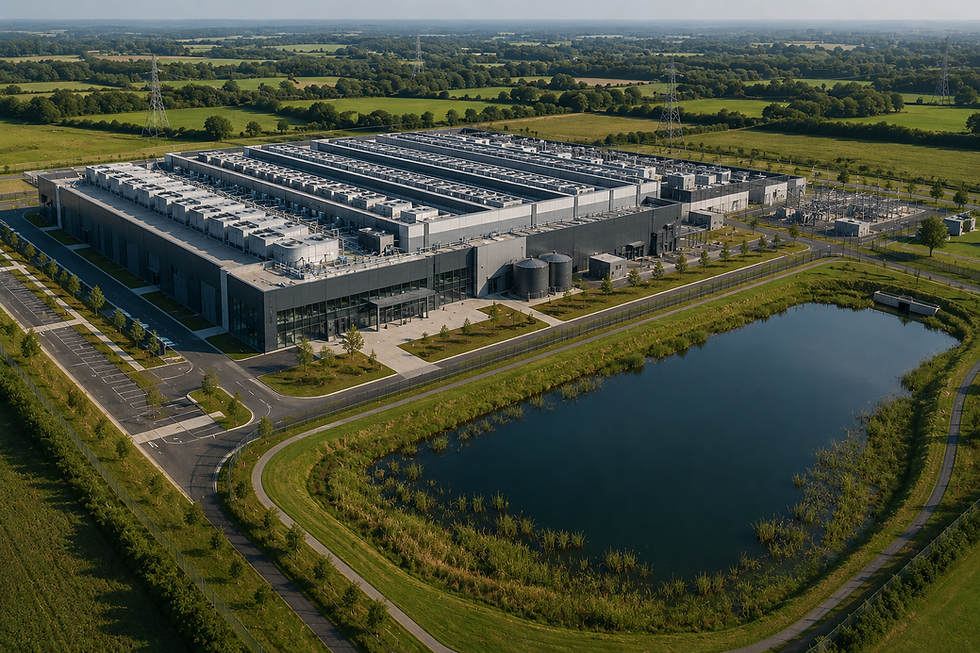
Looking Ahead
As AI continues to transform digital infrastructure, the industry's focus will naturally remain on power generation and grid capacity.
However, the next generation of successful data centres will also be defined by how intelligently they manage another finite resource.
Water is becoming a strategic design consideration rather than simply a utility.
Facilities that integrate resilient cooling strategies, adaptable infrastructure and thoughtful masterplanning will be better positioned to respond to future technological advances, changing environmental conditions and evolving regulatory expectations.
In the years ahead, the question may no longer be whether a site has enough electricity to support a data centre.
Increasingly, it may also be whether it can do so while managing water responsibly.
GTA Perspective
At Gebler Tooth Architects, we believe resilient data centre design begins long before the building itself. Effective masterplanning considers energy, water, operations and future expansion as interconnected systems rather than isolated disciplines.
By embedding flexibility into site planning from the outset, campuses can adapt to evolving cooling technologies, higher-density computing and changing environmental requirements without compromising operational resilience. As data centres continue to underpin the UK's digital economy, designing for responsible water management will become as fundamental as designing for power, security and uptime.


Comments